
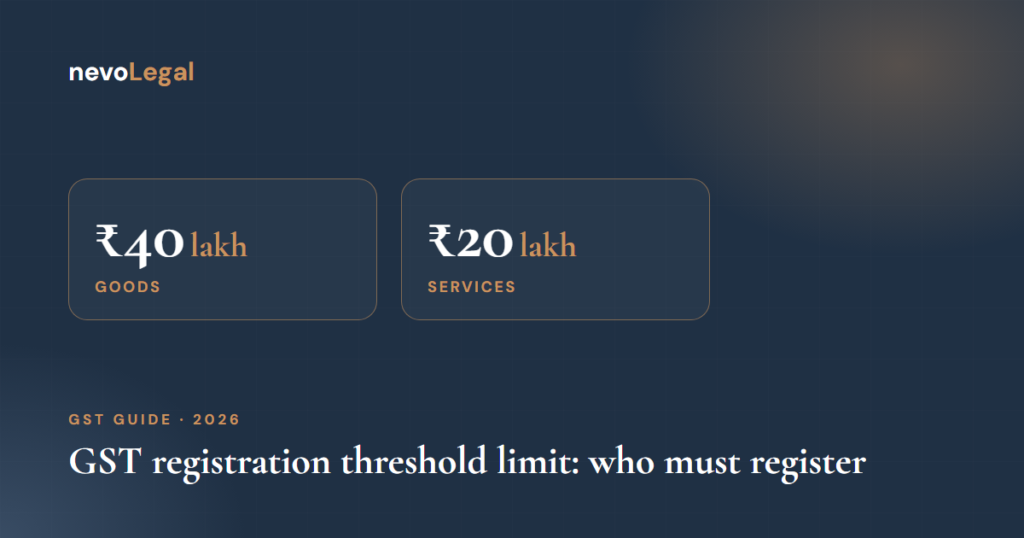
Quick answer: You must register for GST once your aggregate turnover in a financial year crosses ₹40 lakh if you supply only goods, or ₹20 lakh if you supply services (or goods and services). In a few states the limits are lower – ₹10 lakh in Manipur, Mizoram, Nagaland and Tripura. Some businesses must register whatever their turnover, such as those selling goods across state lines or selling through e-commerce platforms that collect tax.
The basic limits
| You supply | Normal states | Manipur, Mizoram, Nagaland, Tripura |
|---|---|---|
| Only goods | ₹40 lakh | ₹10 lakh |
| Services (or goods and services) | ₹20 lakh | ₹10 lakh |
A few points to note:
- The ₹40 lakh limit for goods was introduced in 2019 as an option for states. Some states and union territories – such as Puducherry, Telangana, Meghalaya, Sikkim, Arunachal Pradesh and Uttarakhand – did not adopt it at the time, so goods suppliers there use ₹20 lakh (or ₹10 lakh in the four states above). Check the current position for your state before relying on ₹40 lakh.
- The ₹40 lakh limit is not available to suppliers of ice cream, pan masala and tobacco products, who use the lower limit.
- If you supply both goods and services, the services limit applies.
What counts as "aggregate turnover"?
Aggregate turnover is the total value, across India, of:
- taxable supplies – including those taxed at 0%,
- exempt supplies – such as goods or services that are exempt from GST,
- exports, and
- inter-state supplies
of all businesses that share the same PAN. It does not include GST itself, or purchases on which you pay tax under the reverse charge.
Example: a consultant in Kochi earns ₹16 lakh from Indian clients and ₹6 lakh from a client abroad. Her aggregate turnover is ₹22 lakh – above the ₹20 lakh limit for services – so she must register, even though the export income is zero-rated.
Businesses that must register at any turnover
Under Section 24 of the CGST Act, these businesses need GST registration even below the threshold:
- Inter-state suppliers of goods – selling goods to buyers in another state. (Service providers making inter-state supplies are exempt up to the normal threshold.)
- Sellers on e-commerce platforms that collect tax at source (TCS) – with some relaxations for small suppliers, depending on the type of supply.
- E-commerce operators themselves.
- Casual taxable persons – for example, exhibitors at a trade fair in another state.
- Non-resident taxable persons supplying in India.
- Persons liable to pay tax under reverse charge.
- Persons required to deduct TDS or collect TCS under GST.
- Input Service Distributors.
- Agents supplying on behalf of other registered persons.
- Suppliers of online information and database access services from outside India to unregistered persons in India.
If any of these applies to you, register before you start – don't wait for turnover to build up.
When must you apply?
Apply within 30 days of becoming liable – that is, within 30 days of your turnover crossing the limit, or of starting a business that needs registration from day one.
What if you don't register?
Doing business without registration when you are liable is an offence under the GST law. The penalty is ₹10,000 or the tax evaded, whichever is higher, in addition to the tax itself and interest. You also can't charge GST to your customers or claim input tax credit, which can make you uncompetitive with business customers.
Should you register voluntarily below the limit?
Many small businesses register before they have to. It can make sense if:
- your customers are businesses that want GST invoices so they can claim input tax credit,
- you buy a lot of inputs with GST and want to claim the credit,
- you plan to sell online or across states soon, or
- you export services and want to claim refunds or use an LUT.
But registration also means regular returns and compliance, even in months with no sales. If your customers are mostly consumers and your turnover is well below the limit, it can be simpler to wait.
A faster route for small taxpayers
From 1 November 2025, small taxpayers can opt for a simplified GST registration (Rule 14A of the CGST Rules), meant for businesses whose output tax on supplies to registered buyers is expected to stay within ₹2.5 lakh a month. After Aadhaar authentication, registration is granted electronically within about three working days. If your tax later goes above that level, you must apply to move out of the scheme.
Composition scheme – an option after registering
If your turnover is up to ₹1.5 crore (lower in some states), you can opt for the composition scheme: you pay tax at a low fixed rate on turnover and file fewer returns, but you can't charge GST on invoices or claim input tax credit, and you can't make inter-state supplies of goods. Service providers have a separate composition option with a lower turnover limit. It suits small traders selling to consumers.
How Nevo Legal can help
We check whether you need to register, choose the right type of registration, prepare and file your application, and handle any officer queries until your GSTIN is issued. See our GST registration service. Already registered? We also handle GST return filing and LUT filing for exporters.
Frequently asked questions
What is the GST registration limit for services?
₹20 lakh of aggregate turnover in a financial year, or ₹10 lakh in Manipur, Mizoram, Nagaland and Tripura.
What is the GST registration limit for goods?
₹40 lakh for businesses supplying only goods, in states that adopted this limit. Elsewhere it is ₹20 lakh, or ₹10 lakh in Manipur, Mizoram, Nagaland and Tripura.
Do freelancers need GST registration?
Only if their aggregate turnover, including income from foreign clients, crosses ₹20 lakh – or if they choose to register voluntarily.
Do I need GST registration to sell on Amazon or Flipkart?
Sellers on platforms that collect tax at source generally need registration, though small suppliers have some relaxations depending on what they sell. Check before you list.
Is exempt turnover counted in the GST limit?
Yes. Exempt supplies are included in aggregate turnover when checking the limit.
This article is general information, not tax advice. GST limits and state positions can change – check the current rules or speak to an expert before deciding.