
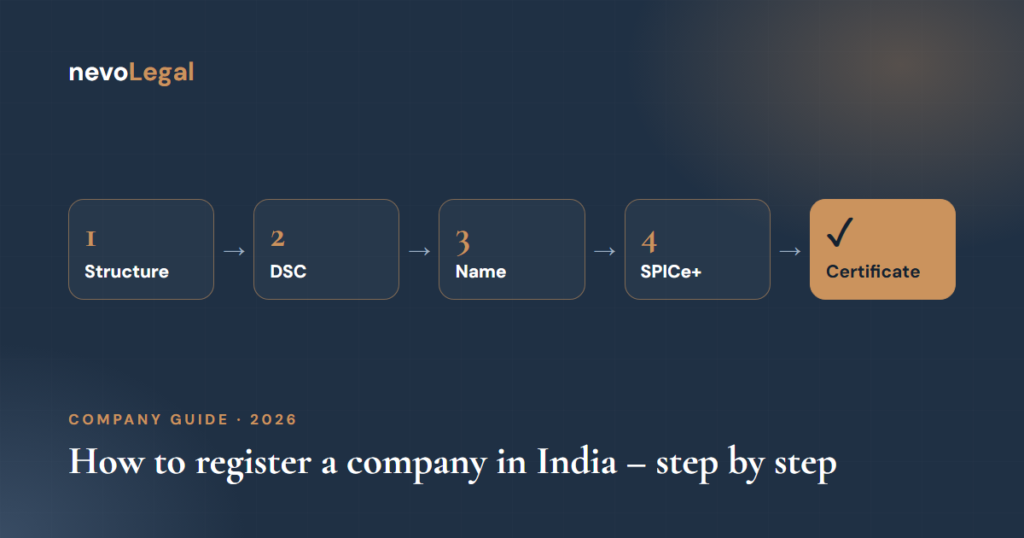
Quick answer: To register a company in India, you (1) choose the structure, (2) get digital signatures for the directors, (3) reserve a name, (4) file the SPICe+ form on the Ministry of Corporate Affairs (MCA) portal with the MOA, AOA and linked registrations, and (5) receive the Certificate of Incorporation with the company's PAN and TAN. The whole process is online and usually takes 7–15 working days. There is no MCA filing fee for companies with authorised capital up to ₹15 lakh – you pay only state stamp duty and the name reservation fee.
Step 1: Choose the right structure
| Structure | Owners | Best for |
|---|---|---|
| Private limited company | 2–200 shareholders, at least 2 directors | Startups and growing businesses that may raise investment |
| One Person Company (OPC) | 1 owner (an Indian citizen resident in India) | Solo founders who want limited liability |
| LLP (registered under the LLP Act, not a company) | At least 2 designated partners | Professional firms and small businesses wanting flexibility |
| Public limited company | At least 7 shareholders, 3 directors | Larger businesses planning wide shareholding |
Most founders choose a private limited company because investors prefer it and ownership is easy to divide into shares. This guide follows that route; the OPC and LLP processes are similar.
Basic rules for a private limited company:
– At least 2 directors and 2 shareholders (the same people can be both). – At least one director must be resident in India. – No minimum capital – you can start with any amount. – A registered office in India where official letters can be received.
Step 2: Get digital signature certificates (DSC)
Every proposed director and subscriber signs the incorporation forms electronically, so each needs a Class 3 DSC. It's issued after online identity verification, usually within a day. See our DSC service.
You don't need to apply for a DIN (Director Identification Number) separately – it is allotted through the incorporation form for new directors.
Step 3: Choose and reserve the name
The name must end with "Private Limited" and must not be identical or too similar to an existing company, LLP or registered trademark.
- Reserve it through SPICe+ Part A on the MCA portal, suggesting up to two names with their significance.
- The name reservation fee is ₹1,000.
- An approved name is reserved for 20 days, so file the incorporation form promptly.
Tip: search the MCA company list and the trademark register before you apply – and plan to register the name as a trademark once the company is formed.
Step 4: Prepare the documents
| For each director and shareholder | For the registered office |
|---|---|
| PAN card | Utility bill (electricity, water or gas) not older than 2 months |
| Aadhaar | NOC from the property owner |
| Address proof – bank statement or utility bill not older than 2 months | Rent agreement, if rented |
| Passport-size photograph | |
| Email address and mobile number |
Foreign nationals and NRIs provide a passport and overseas address proof, usually notarised or apostilled.
Step 5: File SPICe+ Part B
SPICe+ is a single integrated web form for incorporation. Part B includes:
- Company details – capital, registered office and business activity.
- Director and subscriber details – with DIN allotted to new directors.
- e-MOA (INC-33) – the company's objects.
- e-AOA (INC-34) – its internal rules.
- AGILE-PRO-S (INC-35) – linked registrations: GST (optional), EPFO and ESIC, professional tax in some states, and opening the company's bank account.
- Declarations by directors and subscribers, signed with DSC.
A practising chartered accountant, company secretary or cost accountant certifies the form.
Step 6: Pay the fees and stamp duty
| Item | Cost |
|---|---|
| Name reservation | ₹1,000 |
| MCA filing fee | Nil for authorised capital up to ₹15 lakh |
| Stamp duty on MOA, AOA and INC-9 | Varies by state and capital |
| DSC for each director | Charged by the certifying authority |
Above ₹15 lakh of authorised capital, MCA fees apply on a sliding scale.
Step 7: Receive the Certificate of Incorporation
Once the Registrar of Companies approves the application, you get the Certificate of Incorporation with the company's CIN, plus its PAN and TAN – all by email. If the Registrar raises a query, you can resubmit the form with corrections.
After incorporation: your first-month checklist
- Open the bank account and deposit the share capital subscribed.
- Hold the first board meeting within 30 days.
- Appoint the first auditor within 30 days of incorporation.
- File the declaration of commencement of business (INC-20A) within 180 days – a company shouldn't start business or borrow until this is filed.
- Issue share certificates to shareholders within 60 days.
- Register for GST if you didn't through AGILE-PRO-S and you need it.
- Set up statutory registers and minute books.
- Plan your annual filings – financial statements, annual return and directors' KYC every year. Our annual ROC compliance package covers these.
How long does it take?
| Stage | Typical time |
|---|---|
| DSC | 1 working day |
| Name approval | 1–3 working days |
| SPICe+ approval and certificate | 3–7 working days |
| Total | 7–15 working days |
Delays usually come from name rejections, unclear documents or address proofs older than two months.
How Nevo Legal can help
We handle the whole process – DSCs, name approval, drafting the MOA and AOA, filing SPICe+, and the post-incorporation steps – for a fixed fee. See our private limited company registration service.
Frequently asked questions
How much does it cost to register a company in India?
For authorised capital up to ₹15 lakh, there is no MCA filing fee. You pay ₹1,000 for name reservation, state stamp duty, DSCs and any professional fees.
Can I register a company alone?
Yes, as a One Person Company. A private limited company needs at least two directors and two shareholders.
Can I use my home as the registered office?
Yes. Provide a recent utility bill and an NOC from the owner, plus a rent agreement if the home is rented.
Is there a minimum capital to start a company?
No. There is no minimum paid-up capital for a private limited company.
Can NRIs or foreign nationals be directors?
Yes. NRIs and foreign nationals can be directors and shareholders, as long as at least one director is resident in India. Foreign investment must follow FDI rules.
This article is general information, not legal advice. Fees and procedures on the MCA portal can change – check the current position or speak to an expert before you file.