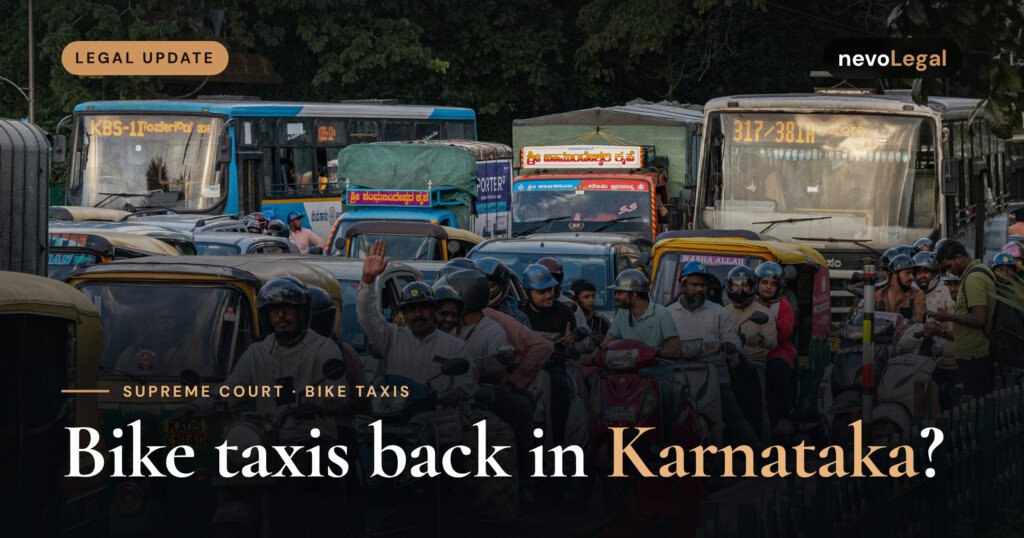
Quick answer: Bike taxis can operate in Karnataka again, but only under the law. On 20 November 2026 the Supreme Court dismissed the Karnataka government's appeal against a High Court judgment that had lifted the ban on bike taxis. The High Court's ruling stands: motorcycles can be registered as transport vehicles and operators can apply for permits, and the State can attach conditions to those permits. It cannot simply ban the service.
What happened
A bench of Justices Satish Chandra Sharma and N. Kotiswar Singh dismissed the Karnataka government's special leave petition (SLP – the route to appeal a High Court judgment in the Supreme Court), according to reports by LiveLaw, Bar & Bench, Deccan Herald and ANI.
- The State had argued that bike taxis raise concerns about passenger safety, insurance cover and the lack of safeguards for riders. Associations of auto and taxi drivers also opposed the services.
- During the hearing, Justice Sharma reportedly said it was "better to regulate it than ban it", and noted that bike taxis already run in about 25 States.
- With the appeal dismissed, the Karnataka High Court's judgment of 23 January 2026 continues to apply.
How the case got here
| Date | What happened |
|---|---|
| 2 April 2025 | A single judge of the Karnataka High Court (Justice B. Shyam Prasad) ordered bike taxi services to stop within six weeks, saying the State could not be forced to register motorcycles as transport vehicles or grant permits until it framed rules. |
| 16 June 2025 | Bike taxi services in Karnataka stopped after the deadline. |
| 1 July 2025 | The Centre issued the Motor Vehicle Aggregator Guidelines, 2025, allowing States to permit private motorcycles to carry passengers through apps. |
| 23 January 2026 | A division bench (Chief Justice Vibhu Bakhru and Justice C.M. Joshi) set aside the single judge's order and lifted the ban. |
| 20 November 2026 | The Supreme Court dismissed the State's appeal. |
The law: what the High Court decided
The dispute turns on the Motor Vehicles Act, 1988. Any vehicle that carries passengers for money is a transport vehicle and needs a permit – a taxi carrying a single booking runs under a contract carriage permit.
According to reports of the 23 January judgment, the High Court held that:
- Motorcycles can be transport vehicles. Nothing in the Act stops a motorcycle from being registered for commercial use, so the transport authorities must consider applications to register bikes as transport vehicles.
- Bike taxi operators can apply for contract carriage permits. The State can attach reasonable conditions to those permits under Section 74(2) of the Act – for example on safety, routes or fares.
- App companies don't need to wait for State rules. The single judge had said aggregators could not run bike taxis until the State notified rules under Section 93 (which governs licences for aggregators). The division bench set that finding aside.
- A blanket ban is unreasonable. The court treated the ban as an unreasonable restriction on the right to carry on a trade or business, which Article 19(1)(g) of the Constitution protects.
Separately, Clause 23 of the Motor Vehicle Aggregator Guidelines, 2025 lets a State allow private (white-board) motorcycles to take rides through an aggregator, using its power under Section 67(3) of the Act, and to charge the aggregator a daily, weekly or fortnightly fee for this. The guidelines are enabling – each State decides whether to use them.
What can happen next
- Operators and app companies can apply to the Karnataka transport authorities for registration of motorcycles as transport vehicles and for permits, as the High Court allowed. Services should run only on that legal footing.
- The State government can frame rules and permit conditions – on rider verification, insurance, helmets for passengers, fares or the number of permits – as long as they regulate rather than ban. It may also choose whether to adopt the private-motorcycle option in the 2025 central guidelines. It can, in theory, seek a review of the Supreme Court's order, though review is granted only on narrow grounds.
- Auto and taxi associations can raise their concerns with the State as it frames those conditions.
What it means for ordinary people
- Riders (passengers): Bike taxis can return to Bengaluru and other cities in Karnataka, but check that the ride is through a licensed operator. Under Section 129 of the Act, a pillion passenger must also wear a helmet.
- Drivers: If you want to earn by giving rides on your bike, register it as required, keep the permit, licence and insurance in order, and follow any conditions the State sets. Running without them can still attract penalties.
Sources
- LiveLaw, "Supreme Court Dismisses Karnataka Govt Plea To Restore Ban On Bike Taxis, Says Better To Regulate", 20 November 2026
- Bar & Bench, "Supreme Court allows bike taxis in Karnataka, rejects State's appeal to restore ban", 20 November 2026
- Deccan Herald and ANI reports, 20 November 2026
- MediaNama and Bar & Bench reports on the Karnataka High Court judgment, 23 January 2026
- Ministry of Road Transport and Highways, Motor Vehicle Aggregator Guidelines, 2025
- Motor Vehicles Act, 1988 (Sections 67, 74, 93 and 129)
How Nevo can help
Planning to start a transport or delivery business, or registering your venture? You can talk to a lawyer about setting up your business or register a private limited company with Nevo Legal.
Are bike taxis legal in Karnataka now?
Yes, subject to registration and permits. The Supreme Court refused to restore the State's ban on 20 November 2026, so the High Court's January 2026 ruling allowing bike taxis under the Motor Vehicles Act applies.
Can the Karnataka government still regulate bike taxis?
Yes. It can attach conditions to permits and frame rules on safety, insurance and fares. What it cannot do is impose a blanket ban without a lawful basis.
Can I use my private bike as a bike taxi?
Not automatically. You need the vehicle registered and permitted as required, unless the State allows private motorcycles through aggregators under the 2025 central guidelines. Check the rules your State has notified.
This article is general information, not legal advice. For advice on your situation, speak to an expert. Nevo Legal takes no side in the dispute between the parties.