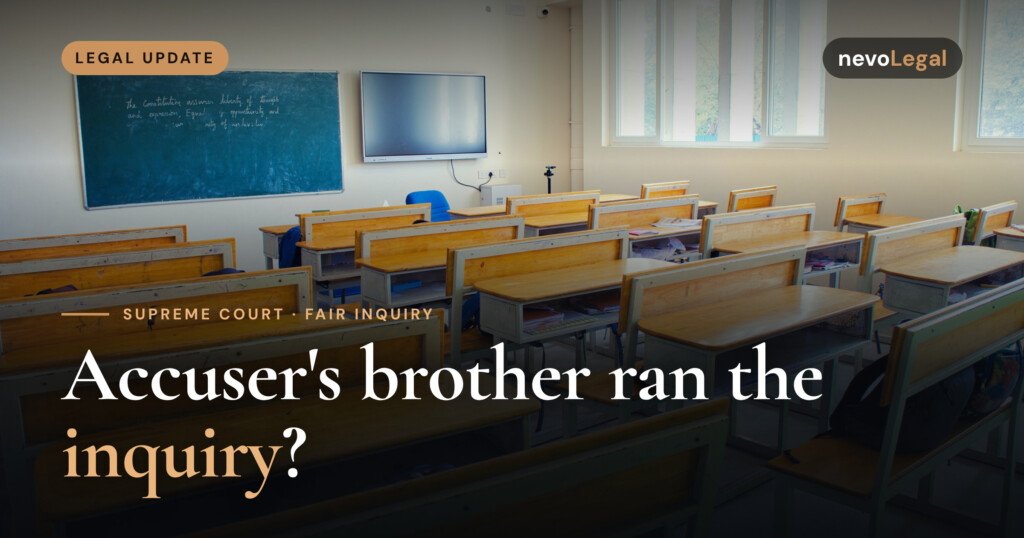
Quick answer: A disciplinary inquiry is not fair if a close relative of the complainant sits on the inquiry committee. On 17 November 2026 the Supreme Court set aside a teacher's termination because the inquiry committee's convenor was the real brother of the school secretary who had made the complaint. The court said the employee does not have to prove actual bias – a reasonable likelihood of bias is enough. It restored her reinstatement with continuity of service and back wages.
What happened
The case is Ku. Kiran D/o Purushottam Bhujade v. Sudhir Shikshan Sanstha & Ors. (2026 INSC 1229; 2026 LiveLaw (SC) 1169), decided by Justices Manoj Misra and Manmohan.
According to the judgment as reported by LiveLaw and LawChakra:
- Kiran Bhujade was appointed as an Assistant Teacher in 2009 at a school run by Sudhir Shikshan Sanstha in Maharashtra.
- In 2021 she faced misconduct charges, including alleged tampering with documents. A three-member inquiry committee was set up under Rule 36 of the Maharashtra Employees of Private Schools (MEPS) Rules.
- The committee's convenor, Prakash Masurkar, was the real brother of the Sanstha's secretary, who was the complainant, the prosecutor and the main witness. Reports say he was the only witness on 11 of the 20 charges.
- She objected to the convenor at the start. The committee rejected her objection, found her guilty by a 2–1 majority, and she was terminated in 2022.
- The School Tribunal, Nagpur, quashed the termination on 21 March 2024, calling the proceedings "a farce of enquiry", and ordered reinstatement with back wages.
- The Bombay High Court reversed this on 29 April 2025, holding that the inquiry was fair. The Supreme Court noted that the High Court had even confused the two brothers' names.
The law: no one should judge a case they have a stake in
This is a basic rule of natural justice – nemo judex in causa sua, "no one should be a judge in their own cause". It applies to courts, tribunals and also to departmental and domestic inquiries at the workplace.
The Supreme Court made these points, relying on earlier rulings such as A.K. Kraipak v. Union of India, Ranjit Thakur v. Union of India and State of U.P. v. Mohd. Nooh:
- The test is likelihood, not proof. The question is whether a fair-minded person would see a real possibility of bias. Asking the employee to show a specific act of bias was wrong.
- Close family ties can disqualify. Kinship disqualifies an adjudicator when it is close enough to create a reasonable likelihood of bias – a brother clearly is.
- A fair procedure does not cure it. Several hearings and cross-examination of witnesses could not fix the problem, because the roles of complainant, prosecutor, witness and judge had merged. In the court's words, the "separation of functions essential to a fair disciplinary proceeding collapses entirely."
- No "necessity" excuse. The doctrine of necessity (a biased person may decide only if no one else can) did not apply, because two unrelated committee members were available.
- No waiver. She objected in time and never accepted the convenor, so she had not given up her right to complain.
What the court ordered
| Issue | Supreme Court's decision |
|---|---|
| Bombay High Court judgment (29 April 2025) | Set aside |
| School Tribunal order (21 March 2024) | Restored |
| Termination | Stays quashed |
| Relief | Reinstatement with continuity of service and back wages |
| Placement | Education Officer to consider absorbing her in another 100% grant-in-aid school (Rule 26(2)(iii), MEPS Rules) |
What it means for employees and employers
If you are facing an inquiry:
- Check who is on the committee as soon as it is formed. Look for relatives, close friends or people under the complainant's control.
- Object in writing, early. Give your reasons and ask for the member to be replaced. A late objection may be treated as a waiver.
- Keep records – the order forming the committee, your objection and the reply.
- Challenge the result if your objection is ignored: before a School Tribunal, labour court, service tribunal or the High Court, depending on your job.
If you are an employer:
- Keep the complainant, presenting officer, witnesses and inquiry officer separate.
- Don't appoint anyone with a family or personal link to the complainant or the employee if someone neutral is available.
- The same principle is useful for POSH Internal Committees and other workplace inquiries: a member with a conflict of interest should step aside.
Sources
- Ku. Kiran D/o Purushottam Bhujade v. Sudhir Shikshan Sanstha & Ors., Supreme Court of India, judgment dated 17 November 2026 (2026 INSC 1229)
- LiveLaw, "Inquiry Vitiated If Complainant's Close Relative Sits In Committee, Proof Of Actual Bias Not Required: Supreme Court" (18 November 2026)
- LawChakra and Law Trend reports on the judgment (November 2026)
- A.K. Kraipak v. Union of India (1969); Ranjit Thakur v. Union of India (1987)
How Nevo Legal can help
If you are facing a departmental inquiry or have lost your job after one, you can talk to a lawyer about labour and service issues. For workplace complaints, see legal advice on workplace harassment. Related reading: can you be removed for overstaying leave because of illness?
Do I have to prove the inquiry officer was actually biased?
No. The Supreme Court said a reasonable likelihood of bias is enough – for example, when the officer is the complainant's close relative.
What if I didn't object at the start?
An early, written objection is important. If you took part without objecting, the employer may argue you waived it, though courts look at the facts of each case.
Does this apply to private companies?
The ruling arose from a private aided school governed by Maharashtra rules, but the principle against bias applies to most disciplinary inquiries, including domestic inquiries in private employment.
This article is general information, not legal advice. For advice on your situation, speak to an expert.