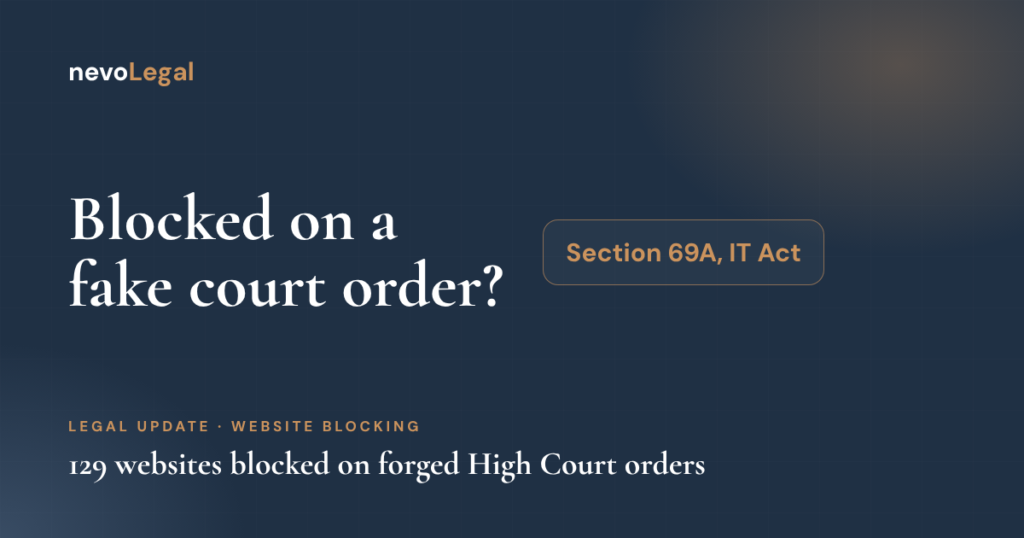
Quick answer: Reuters reported on 11 November 2026 that the Department of Telecommunications (DoT) told internet providers to block 129 betting websites on the strength of two High Court orders that the courts say were never passed. Police in Uttar Pradesh have registered an FIR for forgery and cheating. The case is a reminder that in India a website can be blocked either by the government under Section 69A of the IT Act or on a court's order – and that any fake court order can be checked against the court's own records in a few minutes.
What happened
According to a Reuters investigation published on 11 November 2026, and reports in LiveLaw and Bar & Bench:
- The DoT issued two blocking directions to internet service providers – one on 21 July 2026 covering 34 sites, and one on 2 September 2026 covering 95 sites.
- The first relied on a purported order of the Rajasthan High Court; the second on a purported order of the Allahabad High Court dated 14 August 2026. The sites were described as betting platforms, some allegedly streaming fake cricket matches.
- Reuters found that neither order appeared in the courts' online records. The Allahabad High Court's own inquiry found that no such order had been passed. The Rajasthan High Court's registry said its order appeared to be fraudulent.
- The fake Allahabad order carried the court's logo, seal and a QR code – but the QR code led to an unrelated page, reports say.
- On the Chief Justice's direction of 3 November, the Allahabad High Court's Joint Registrar filed a complaint and the UP Police registered an FIR against unknown persons on 6 November.
Reuters said it could not establish who made the documents. The DoT did not respond to Reuters' questions, and as of 11 November no arrests had been reported. Nothing reported so far shows that any official knew the orders were fake.
The law: two ways a website gets blocked
1. Government blocking under Section 69A of the IT Act, 2000
Section 69A lets the Central Government block public access to online information if it is necessary in the interest of India's sovereignty and integrity, defence, security of the State, friendly relations with foreign States, public order, or to prevent incitement to a cognisable offence. Reasons must be recorded in writing.
The procedure is in the IT (Procedure and Safeguards for Blocking for Access of Information by Public) Rules, 2009:
- A designated officer of the Ministry of Electronics and IT receives blocking requests from ministries and state governments.
- A committee of officers examines each request, and the owner of the content or the platform should be given notice and a chance to reply.
- In an emergency (Rule 9), the officer can block first, but the request must go to the committee within 48 hours.
- A Review Committee must meet at least once every two months to check that blocking directions follow the law.
In Shreya Singhal v. Union of India (2015), the Supreme Court upheld Section 69A and these rules, pointing to these safeguards – reasons in writing, a hearing, and review.
2. Blocking on a court's order (Rule 10)
Courts often order websites blocked – for example, in copyright cases against pirate streaming sites, or against illegal betting platforms. Under Rule 10, when a court orders a block, the designated officer acts on a certified copy of the order. The DoT, which licenses internet providers, then tells them to block the sites.
A court-ordered block does not go through the committee, because the court has already decided – which is why checking that the order is genuine matters so much.
The crime: forging a court order
The FIR, as reported, invokes several sections of the Bharatiya Nyaya Sanhita, 2023 (BNS):
| BNS section | Offence | Maximum punishment |
|---|---|---|
| 318(2) | Cheating | 3 years, or fine, or both |
| 336(2) | Forgery | 2 years, or fine, or both |
| 336(3) | Forgery for the purpose of cheating | 7 years and fine |
| 337 | Forgery of a court record or public register | 7 years and fine |
| 340(2) | Using a forged document as genuine | Same as for forging it |
What can happen next
- Police investigation: The UP Police will try to trace who made and sent the documents, and how they reached the DoT. If someone is identified, they can be charged under the sections above.
- Review of the blocks: The DoT or MeitY can withdraw or re-examine the directions. A block based on a non-existent order has no court backing, though the government may still act against illegal betting sites under its own powers.
- Website owners: A person whose site is blocked can write to MeitY's designated officer, approach the court named in the order, or file a writ petition in a High Court under Article 226. A fake order being used does not make an illegal business legal – real-money online betting is banned under the Promotion and Regulation of Online Gaming Act, 2025.
What it means for ordinary people and businesses
The same trick – a document dressed up as a court order – is used against ordinary people too: fake "court summons" by email, "arrest warrants" on WhatsApp, or notices from recovery agents. Before you act on any court order:
- Note the case number, court and date on the document.
- Search the court's official website (case status) or the eCourts portal for that case number. A genuine High Court order is normally uploaded there.
- Don't rely on the QR code or seal alone – in this case, both were on the fake order.
- Ask the court registry or a lawyer if you can't find it, and ask for a certified copy.
- Never pay money to someone because a "court order" says so on WhatsApp or email. Courts don't collect fines that way.
If you have received a suspicious notice, our guide on how to spot a fake legal notice explains the warning signs. If you have lost money to a scam that used a fake order, file a complaint on the National Cyber Crime Reporting Portal (cybercrime.gov.in) or call 1930 as soon as possible.
Sources
- Reuters investigation on the fake court orders and website blocks, 11 November 2026.
- LiveLaw, "Fake Allahabad High Court Order Cited In Centre's Takedown Directive For 95 Websites; UP Police Register FIR", November 2026.
- Bar & Bench, "UP Police registers FIR after forged Allahabad High Court order leads to takedown of 95 websites", November 2026.
- Information Technology Act, 2000, Section 69A, and the IT (Procedure and Safeguards for Blocking for Access of Information by Public) Rules, 2009.
- Bharatiya Nyaya Sanhita, 2023, Sections 318, 336, 337 and 340.
- Shreya Singhal v. Union of India, Supreme Court of India, 24 March 2015.
How Nevo can help
Received a court notice, summons or legal notice and not sure it's real? You can talk to a lawyer to check it, or get help with a cyber crime complaint if you've been targeted.
This article is general information, not legal advice. It reports an ongoing investigation and makes no finding about any person's guilt. For advice on your situation, speak to an expert.