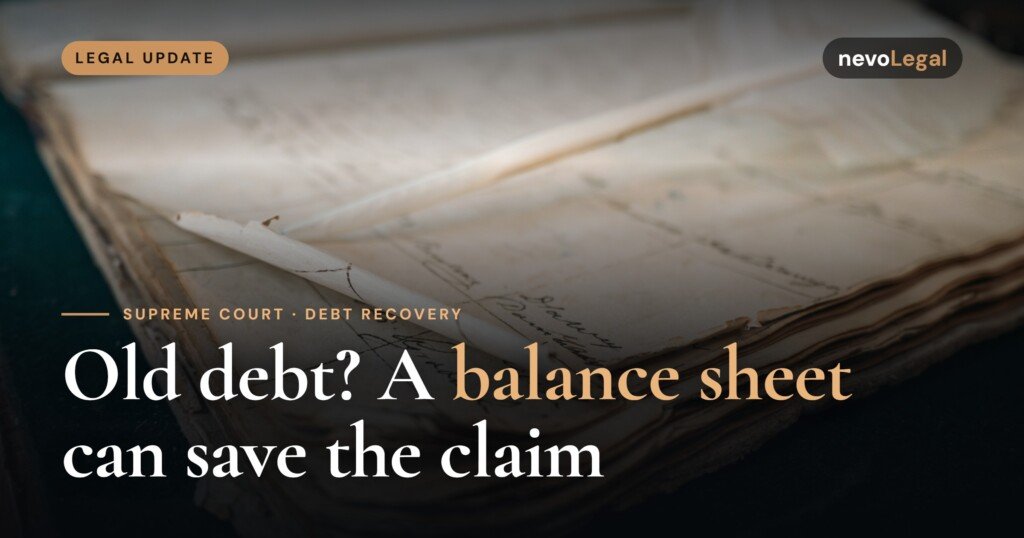
Quick answer: Most suits to recover money must be filed within three years. But if the debtor admits the debt in writing before that time runs out, the clock starts again. On 6 November 2026 the Supreme Court held that an acknowledgment of debt in a balance sheet – read with the debtor's other records – can be such an admission under Section 18 of the Limitation Act, 1963. It revived a contractor's recovery suit that the Delhi High Court had thrown out as too late.
What happened
The case is Yusuf v. Vigyapan Loke Delhi Advertising CGHS Ltd. (reported as 2026 INSC 1207), decided by a bench of Justices Vikram Nath, Augustine George Masih and Sandeep Mehta.
According to reports by LiveLaw, SCC Online and Verdictum:
- A contractor did work for a Delhi cooperative group housing society. According to the society, his bills dated back to 2000–2003.
- He filed a suit to recover the unpaid money in 2014.
- The society asked the trial court to reject the suit at the start under Order VII Rule 11 of the Code of Civil Procedure (CPC) – the rule that lets a court throw out a plaint (the written claim) that is barred by law. It said the claim was hopelessly time-barred.
- The contractor relied on the society's own balance sheets, which carried the outstanding amount forward year after year from 2004 to 2013, and on its bank reconciliation statements, which recorded cheques issued to him.
- The trial court refused to reject the suit in January 2020. The Delhi High Court later sided with the society and rejected the suit.
- The Supreme Court set aside the High Court's order and sent the suit back to the trial court.
The court has not decided that the society owes the money. Whether the claim is genuine, and how much is due, will be decided at trial.
The law: limitation and acknowledgment
Limitation means the time limit for going to court. Under the Limitation Act, 1963, a court must dismiss a suit filed after the time limit, even if no one raises the point (Section 3). For most money claims – unpaid bills, loans, price of goods or work – the limit is three years.
Two sections can restart that clock:
| Provision | What restarts the clock | Key condition |
|---|---|---|
| Section 18 – acknowledgment | The debtor admits the liability in writing | Must be signed by the debtor (or its agent) before the limitation period ends |
| Section 19 – part payment | The debtor pays part of the debt or interest | Payment must be made before the period ends, and be shown in writing |
Each fresh acknowledgment starts a new three-year period from the date it was signed.
Why a balance sheet can count
A company or society's balance sheet is a signed financial statement. If it shows an amount owed to creditors, that can be read as the debtor admitting the debt. The Supreme Court had already accepted this in Asset Reconstruction Company (India) Ltd. v. Bishal Jaiswal (2021).
In this new ruling, according to the reports, the court added:
- The acknowledgment need not name the creditor or follow any fixed format.
- It must, read with the surrounding records and circumstances, show that a debt still exists between the parties.
- Balance sheet entries, read with bank records and transactions, can be enough – so a suit should not be thrown out at the very start just because the original bills are old.
- Each later balance sheet that carries the debt forward can start a fresh period of limitation.
The court did not lay down a rule that every balance sheet entry always extends time. Notes to the accounts and any qualifications in the auditor's report also matter.
What it means for businesses and creditors
If you are owed money:
- Don't assume an old debt is dead. Check whether the debtor has admitted it in writing since – a letter, an email, a signed statement of account, a confirmation of balance, a part payment, or its published accounts.
- Collect the evidence early. For companies, balance sheets filed with the Registrar of Companies can be obtained from the MCA portal. Keep bank statements showing cheques or part payments.
- Count from the latest acknowledgment. The three years run from the most recent written admission signed before the earlier period ran out.
- Send a legal notice. A clear demand often prompts payment, and the reply itself can sometimes amount to an acknowledgment.
- Don't wait for the last month. Limitation is strict; a suit filed even a day late can be dismissed.
If you owe money or keep the books:
- What you show in your accounts matters. Carrying a creditor's dues in your balance sheet can keep that creditor's claim alive.
- If you genuinely dispute an amount, take advice from your accountant and a lawyer on how to show it.
Sources
- LiveLaw, "Balance Sheet Entries Can Count As Acknowledgment Of Debt Under S.18 Of Limitation Act: Supreme Court" (2026 LiveLaw (SC) 1149), November 2026
- SCC Online Blog, report on Yusuf v. Vigyapan Loke Delhi Advertising CGHS Ltd., 10 November 2026
- Verdictum, report on 2026 INSC 1207, November 2026
- The Limitation Act, 1963 – Sections 3, 18 and 19 (India Code)
- Asset Reconstruction Company (India) Ltd. v. Bishal Jaiswal, Supreme Court, 2021
How Nevo can help
Chasing unpaid dues? Our lawyers can draft and send a legal notice for recovery and check whether your claim is still within time. You can also talk to a lawyer about loan or money recovery. For a do-it-yourself start, read our guide on the legal notice format in India.
Can I recover money after 3 years in India?
Possibly. If the debtor admitted the debt in writing, or made a part payment, before the three years ran out, a fresh three-year period starts from that date.
Does a WhatsApp message or email count as acknowledgment?
It can, if it clearly admits the debt and can be shown to come from the debtor. Courts look at the exact words and the circumstances, so keep the original messages.
Does this ruling mean the contractor will get paid?
No. The Supreme Court only allowed the suit to go ahead. The trial court will decide whether the money is actually owed and how much.
This article is general information, not legal advice. For advice on your situation, speak to an expert.